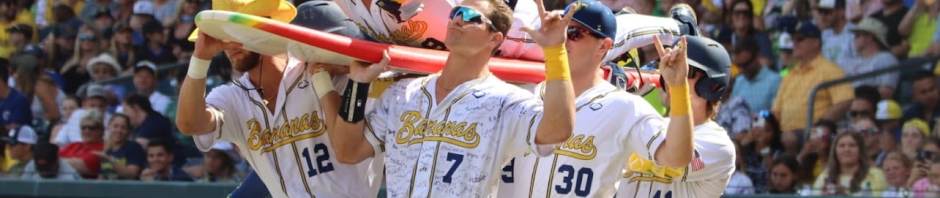
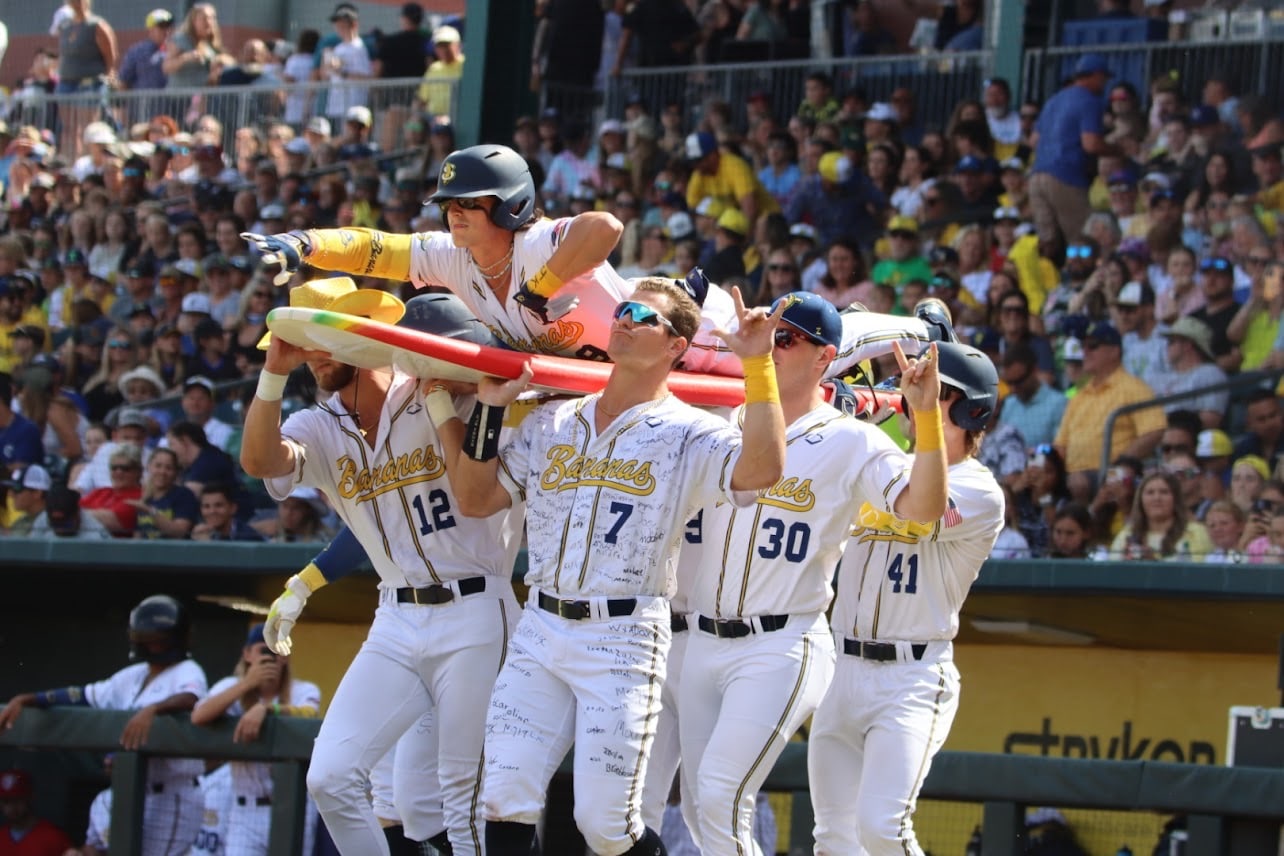
The Savannah Bananas are sort of a unique entity in the social media era in that their rise to massive popularity took place before the types of people with opinions on things like that had the chance to construct, aim, and fire them, which has left them infuriatingly enigmatic to that population (of which I am a member). Their success feels simultaneously inexplicable and unsatisfyingly simplistic in its explicability.
Their tour sells out ballparks and football stadiums that their full time tenants struggle to sell out. As the World Wide Leader in Sports Entertainment backs away from Major League Baseball, they’ve leaned into Bananaball. After securing Bananas tickets through their apparently cutthroat lottery system, your coworkers and friends, who have never cared about baseball, exhale sighs tinged with that palpable ‘I didn’t ruin Christmas this year’ relief.
Banana supporters, if asked about their appeal, will respond simply. “It’s Fun!” They mean it earnestly, with no further explanation required for that sort of thing from their end, which tends to drive those of us who crave explanations for those sorts of things on our ends absolutely insane.
Read more: Seven Proposed Alternative Conceptual Visions of the Savannah BananasI bring sort of a unique perspective on this, as I was was there from near the beginning of their rise, back in May 2022, when the Bananaball World Tour made an early stop in Legends Field in Kansas City, Kansas (the house that Birahim Diop built), to play a Bananaball exhibition against our independent minor league team, the Kansas City Monarchs. My friend Mike and I paid our fifteen dollars for SRO tickets because we wanted to see Spaceman Bill Lee pitch an inning in his seventies, but we left with generally positive feelings about the Bananaball experience. They gimmicky rules were at least unique and engaging, the rule on fans catching foul balls for put-outs especially so, and I left the ballpark sincerely charmed with good wishes for these yellow-clad dreamers.
I liken it to the time that I saw both Turnstile and Big Thief, neither of whom I’m particularly interested in, perform at a music festival. Regardless of whether I’d go purchase an album of theirs on CD, I recognized the intense, life-affirming connection that those two acts have with their fanbases, and as a result still feel positively about them both. I hadn’t really looked back at the Bananas until I saw them selling out Clemson’s football stadium from across a Mexican restaurant back in April with three years of honing and optimizing the Bananaball gestalt under their belts, which has seen them leaning hard into the silly mass choreographed dances, the retired local MLB heroes, and far more romantic reality show hearthrobbery involving the players1.
To swerve hard into another music metaphor, I imagine I’m like one of the people who bought Sugar Ray’s second album because I enjoyed thrash metal, ignored the secret track at the end, then heard “Someday” over the store speakers at K-Mart in 1999. Whatever first drew me to them is not what they’ve chosen to ride to success.
Larger questions pervade (e.g. is this good for baseball, are they baseball’s equivalent of the Globetrotters, is this ONANite, etc.), but they are larger than the scope of this piece, though I’ll take a stab in a footnote.2
No, today, I want to extrapolate the Bananas’ success based on the variability of its component parts, offer that as an explanation for their rise to prominence, and then pitch alternative variables for entrepreneurs looking to get in on the ground floor of gimmick sports themselves.
This is the definition of Bananaball that I’ve developed, with emphasis added to what I believe are the two key defining variables, along with the extra motivations that served as the sort of secret sauce for their rise:
Bananaball is baseball with [stratified new rules] and [low stakes], designed to go viral on TikTok by offering choreographed dances to overstimulated children, retired professional players to their nostalgic fathers, and romantic thirst-traps to their horny moms.
The stratification and seriousness can serve as an X and Y axis, as diagrammed here:
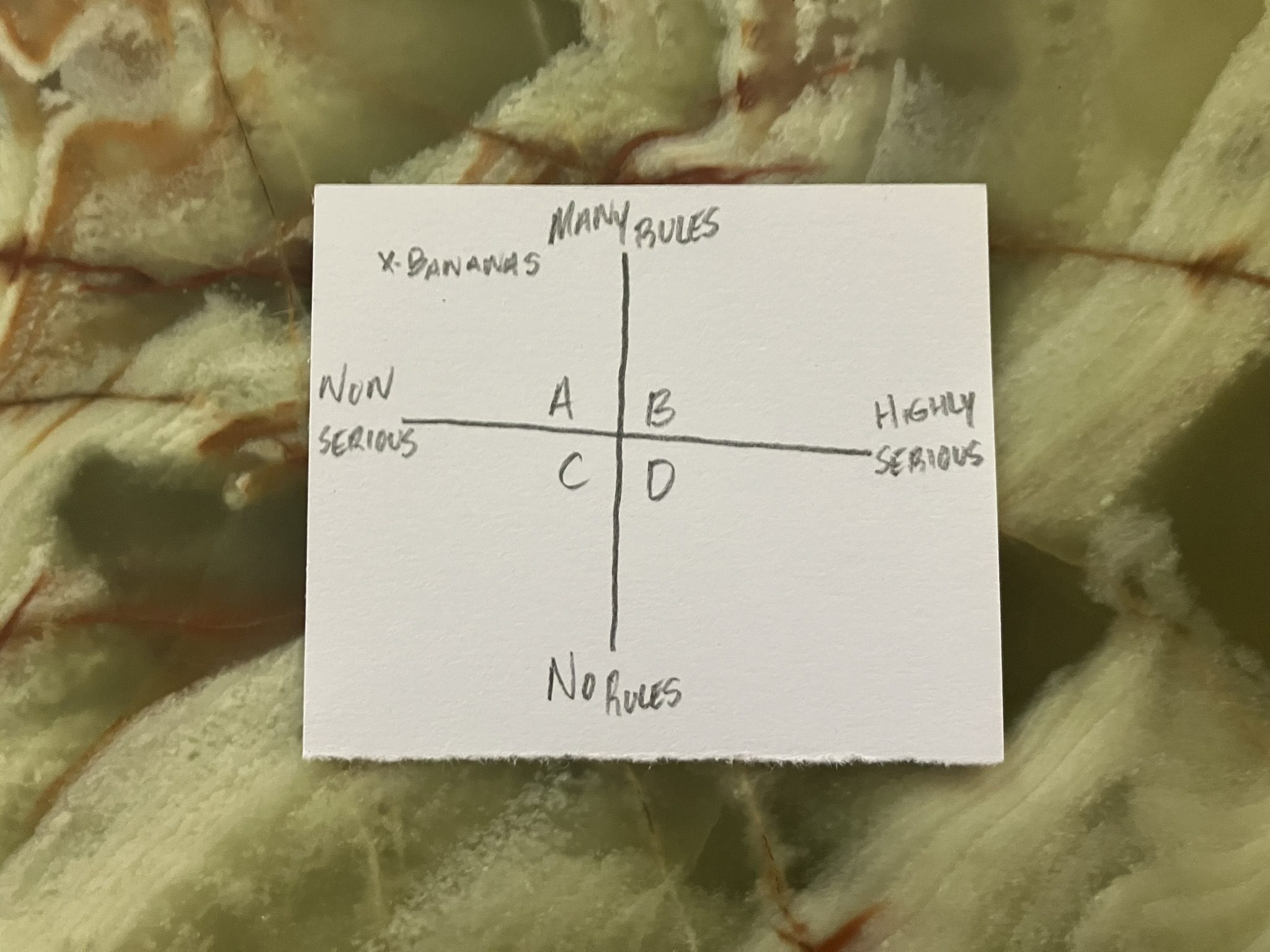
If the Bananas occupy the extreme boundary of Quadrant A, there may be gold to be mined from quadrants B, C, and D as well.
Quadrant B: High-stratification, High-seriousness
The rules adopted by the team that I’m imagining here may not be as explicit as the Bananas’, and certainly not as crazytown-cuckoo-bananapants as the Bananas’. Instead, this highly-serious team should lean into the sport’s proud history of arcane unwritten rules. In one sense, this team could be the Anti-Bananas, the team that the disgruntled father, out $400 and left to drive home with an overstimulated, fit-throwing child in the backseat and a reminder of his sexual inadequacy in the passenger seat, buys tickets to see out of revenge, akin to Mike Mitchell sitting his daughters down to watch the original Shworvels TV show in that Birthday Boys sketch that I’m certain was as impactful to you readers as it was to me.
This team is bereft of antics, of gimmicks, of flash and fancy to a ludditic degree. Cut the dancing and the stilts, sure, but take the music, the video board, and the PA with you too. There’s no Kiss Cam, no Hot Dog Race, no Swedish Songwriters, just pure, uncut fucking baseball.
Our two teams (working names are the Horton Spartans and the Salinas Ascetics) arrive in white and gray uniforms numbered 1-9, play ball, and depart. Spectators have to put their phones in those little lock bags from comedy clubs. The concessions include hot dogs with tomato ketchup and yellow mustard, plus water, 7-Up, and Lager for the adults.
The Spartans and Ascetics will build focus and put hair on the chest. Fans are not disallowed from chanting or singing, but it will not be prompted. Fans determine whether they’re Spartan or Ascetic fans based on whim and whatever minor gasps of personality crack through the curtain of serious baseballing before those gasps earn said personality a fastball to the dome during their next at-bat.
Players are not necessarily anonymized, as they are named on cards passed out to guests upon entry, but there is obviously no TV broadcast or Social Media feeds from which to glean anything else about our heroes. There is a live radio broadcast, done Ronald Reagan style from a studio in Des Moines based off of play-by-play statistics transmitted from the ballpark to the announcer via telegram. The only advertising takes the form of flyers and billboards which read “The Horton Spartans are Coming to [Town Name] to Play Baseball against the Salinas Ascetics on [Date] at [Location], tickets are ten dollars cash at the gate per person.
Our target audience: Dads, Granddads, Joe Bush
Q3: Low-stratification, Low-seriousness
For this, I picture some kind of baseball bacchanalia, something closer to an avant-garde theatre troupe or performance art act than a sport, the only thing keeping it from devolving out of the athletic sphere being the most definitional aspects at the foundation of baseball itself: A ball will be thrown, a bat will be swung, and gloves will be worn, but the itchier details of scoring, umpires, outs, innings, at-bats, batting orders, and so forth, are left to the interpretations of players and spectators alike. The shape and ritual of baseball remains, and ought to be identified, but the fans’ interests are not dead-set on any competitive venture, sort of like attending a Terror Pigeon Dance Revolt show in the early 2010s.
Likewise, many of the sport’s prohibitions will be eschewed as well. Who is to say, for example, that we couldn’t put a stand-up bass at first (First Bass, perhaps) to be taken up by a baserunner in accompaniment with the trio of first baseman, first base coach, and umpire on drumset, keyboard, and Tenor Sax as sort of a rotating jazz combo? Why not have the third baseman and third base coach trade off as MC Serch and Prime Minister Pete Nice to resurrect 3rd Bass at Third Base, with the baserunner or umpire trading off duties as DJ Richie Rich? Why not codify baseballing legends of yore like Who, What, and I Don’t Know as de facto names for those base positions? Why not give baserunners the chance to make a defensive play if they’re in position? Why couldn’t there be fornication in the dugouts? Why not give outfielders the space to twirl and frolic in the grass?
At the game’s end, which arrives when everyone understands it to have done so, fans discern whether they’ve won or not, what they’ve learned, if anything, and how to process it, if desired. As for a name, I suppose that only fits to put on the viewer as well. Either that or the Of Montreal Expos.
Our target audience: The theatre kids, the art kids, Joe Bush
Q4: Low-Stratification, High-Seriousness
The Ballplayers’ Unaffiliated Movement for Liberation, Action, and Baseball (BUMLAB) is an amorphous coagulation of genders, races, ages, and baseball competence bound together by the distinct belief that some kind of ideologicospiritual advancement will take place as a result of their combined efforts every night on the baseball diamond. Many could not describe what that ideologicospiritual advancement would be, and those brave enough to try would present far different descriptions from even their closest comrades on the diamond. Nonetheless, they are pulled to this, believe this some path to a secular sort of salvation, and they play what is identifiably baseball in turn, with a tenacious, often violent drive pushing them forward.
The question of roles is solved by relations between infield, outfield, pitcher’s mound, batter’s box, on-deck circle, dugout, and bullpen, with the mere act of performing these roles enough to replace questions of whether or not one need fulfill them. For example, a pitcher and catcher perpetually, though the performers’ identities change throughout the endeavor, perform the act of “warming up” in both bullpens. Though some exigence to barnstorm may have once existed, and may still echo quietly in the souls of those in place along with countless once-held beliefs and intentions inside and outside of baseball, the rotation system ensures that the play persists perpetually, with spent players rotating out for breaks to eat, drink, sleep, put in a shift at Kinko’s, et cetera, before returning to the field.
The size of the BUMLAP is undefinable, membership only identified when at the park. Spectators and on-lookers often become so enamored by this sisyphean exercise that they feel the pull themselves and become drawn in, walking without forethought from the bleachers to the diamond, a glove exchanged with nothing but a glance, a position identified in absentia. Indeed, much of the game happens in silence, the few vocalizations given only out of an undefinable internal compulsion. One embodying the managerial role, for example, may be compelled to perform a Pinellian temper tantrum, and indeed they may, and indeed they will vocalize, though which words are vocalized rarely relate to the situation at hand, if they are indeed understood as a language at all. They in the umpire’s role will perform the act of arguing and ejecting them, and they in the manager’s role will walk in performed jilt back to a dugout before silently handing off roles with another comrade. This happens without any requisite close or missed calls, and tirades last between thirty seconds and six hours.
Identifiably baseballing acts, some directly descended from real baseballing moments, will occur in an unpracticed, but well-coreographed fashion. They in the mascot role becomes Youppi, asleep atop a dugout while they in the manager role embodies Tommy Lasorda and berates them from below. Batters may perform Carlton Fisk waving the ball fair, George Brett’s pine tar freakout, and Amir Garrett’s attempt to fight the Pittsburgh Pirates. A hill behind the right field wall serves frequently as the spot to embody the roles of the infamous exhibitionists of the SkyDome Hotel. In one instance, an impulse overcame BUMLAP members, prompting them to silently pile disco LPs in center field over the course of weeks, which stood for months before one embodying the Bill Veeck role lit them ablaze.
They play on, the BUMLAP does. One day you and I both may be compelled to join this Cargo Cult to baseballing form just as well. When I make eye contact with you and extend a glove to you, take it.
Our target audience: The lost, the broken, the forgotten, the directionless, Joe Bush
The more complex, and perhaps more dangerous, variables are the TikTok-fodder components for which the Bananas have optimized themselves. With the dancing, the nostalgia, and the thirst traps, they’ve managed to perfectly scratch itches ingrained in the internet users of 2025. But these are not the only itches present online, and it must prompt the question: What other components of internet virality could we exploit?

Baseball, but with True Crime
If there’s one thing that leeching off of my parent’s Netflix account every time that I dogsit for them has shown me, it’s that We Love It When Someone Is Murdered Under Mysterious Circumstances. This shouldn’t be too hard to adapt to baseball.
It all starts with an attractive woman who serves as an MC. She’s jovial, effusive, and has some sort of seemingly genuine connection with everyone on both teams, from the managers to the players, to the mascots, et cetera. We all come to admire her for her commitment to the game of baseball and her seemingly endless supply of humanistic love. She drops thoughtful compliments to everyone: ‘Oh, second baseman, I notice that raising your elbow up on your swing, which you’ve worked so hard at all summer, is starting to pay off in your batting average.’ ‘Manager, I could’ve mistaken you for a player in that uniform with how physically fit you’ve kept yourself.’ ‘Mascot, you took that spill off of your ATV so smoothly. That sort of thing.’ She has a tragically perfect name like Angel or Grace or Martyr.
She hands the microphone to a young child with life-affirming needs that she knows personally from a charity with whom she volunteers but doesn’t make a big deal about it to sing the national anthem and she descends to the tunnel beneath the stadium… Seconds after the anthem, she screams. Cameras cut to her, bloodied and staggered on the tarmac beneath. She manages to mutter two final words: Play Ball.
We spend nine innings analyzing the actions of each player on the two teams. A team of new MCs enter the fray at this time. I imagine we have a classic hard-boiled noir detective, a YouTube guy who’s abnormally focused on doing research around the case, and a podcast host type that toes the line between gallows humor and tastelessness. Each partakes in interstitial interrogative interviews with various stakeholders from both teams, the fans get to play amateur body language experts (e.g. is he sweaty because he’s nervous about getting caught or because he just had to dive to track down a fly ball and fire it back to second to turn a double play?) Fans also receive detailed programs that describe the links between our slain host and each potential perpetrator so as to determine motives.
Around the top of the ninth, spectators can cast their votes for who they believe to be the guilty party via text message. Once final out is called, we reveal the final standings on the jumbotron. Just as we’re about to declare the top vote-getter guilty, someone from the video booth will come out having exhumed a yet-unseen security video of the tunnel at the moment of the crime, which will reveal the actual perpetrator. If the audience was wrong, then they have to live with the shame of having sentenced an innoccent person to life as a convicted felon, and if the audience was right, they’ll get half off of a sub sandwich with proof of ticket purchase in that particular sub sandwich chain’s app (in all likelihood it’s going to be Blimpie’s, fair warning).
Intended Audience: Podcast fans, whoever is watching the new missing lady documentary that Netflix drops on like a weekly basis, Agatha Christie fans, Joe Bush
Baseball, but with Unhealthy Parasocial Relationships
I think the Bananas could reach this on their own if they play their cards right. I also think this might work better with a smaller-sized team sport like basketball, as with fewer players to pick from, you’ll probably avoid some of the archetypical overlap that is bound to occur with two baseball teams. This would probably work best as a co-ed outfit as well, as you’ll be able to draw in parasocially-minded fans from a wider base.
At the groundwork here, every player, coach, administrator, batboy, grounds crew worker, et cetera, will be fully plugged into the Fanum-style 24-hour Twitch streaming matrix. We’ll also write up a backstory for each participant that is engineered to appeal to a certain niche subset of potential fan. Whether that appeal is romantic or platonic is irrelevant, and ideally participants will form parasocial relationships with fans in both forms. For example, maybe there’s a hunky, wholesome, man-of-faith left fielder who appeals to the Christian women as an object of romantic desire and to the Christian men as a role model and aspirational figure. Maybe there’s an emo third basewoman who speaks to straight emo-slash-scene women on a level that nobody else does, appeals to straight emo-slash-scene men and gay emo-slash-scene women (or really anyone with that sort of romantic attraction to her) as a crush, and appeals to older men in sort of a paternalistic ‘well if this girl’s rebelled like this and has found a career in baseball, perhaps my daughter’s rebellion may lead her to a similar career path and she’s not so doomed after all’ sort of sense. Maybe the organist is a heartthrob organist, an object of crushes to some and a very good organist to those who care about playing the organ well.
There will be little cliques and alliances within their teams, and there will always be a palpable ‘will-they-won’t-they’ thing going on between players, though for the sake of the business operations here they cannot actually act on any built-up romantic tension (as this only works if audiences think that they have a chance).
Fans then arrive at the ballpark in an absolute lather (we also have to hammer home the idea that this might be their only shot to impress the particular object of their affection. Maybe whenever one of the players leaves or gets fired we instruct the other players to say “Man, I sure feel bad for any of their fans that weren’t at our game in Shreveport. You never know when your last chance will be to see one of us, it’s best to make the most of it as soon as you can”). Security will have to be incredibly tight. We want to avoid one of those incidents where a lovestruck fan risks tooth, limb, life, nail, etc. to grab the attention of the object of their affection. We don’t want a Chase Utley situation.
Provided our players have the mental fortitude to survive the ridiculous torment nexus of 24-hour streaming, I can see a disgustingly profitable endeavor here. Take all the gate receipts, broadcast deals, merch sales, and concessions, then add in those Twitch subscription and chat message awards they’ll soak up throughout the week? Oh my god, we’re in Embryonic Beer territory. Then of course there’s the tangible comparative potential of Twitch viewcounts we can use to pit players against one another in pursuit of popularity? Oh my god. It’s too good. It’s evil, and it’s representative of the absolute depths to which the internet has brought our culture… but if I were in charge of a small-market MLB outfit straddling the Missouri river, I’d at least hire me to consult on it.
Intended audiences: The lonely, the desolate, the desperate, the friendless, the ones who watch it and make fun of it but also sort of need whomever they’re making fun of to continue making stuff, actually not Joe Bush this time, this entire thing baffles me and I only know who Fanum is from reading an interview with him in Gentleman’s Quarterly
Baseball, but with cruelty and bullying:
It is the diametry at the core of internet relations. There are winners and there are losers. There are Jocks and nerds, alphas and betas, Chads and Virgins, Stacies and Girlfailures, trolls and normies, goons and redditors, cows and lemmings, and plenty more. One bullies the other into submission, has since the beginning of time, and will continue to do so henceforth until we each slough off this plane of existence or at least log off of our social media platform of choice.
There is already cruelty and bullying in America’s Pastime, and winning and losing is at the core of it to begin with, but we may appeal to expanded audiences if this cruelty and bullying is turned explicit. I propose two teams: the Branson Bullies and the Newton Nerds. This takes the Globetrotters/Generals model to its most logical ends.
The Bullies are a melange of your archetypical bullies of culture: There are plenty of letter-jacketed jocks, yes, but there’s room for the denim-vested ones who work out their difficult home lives on their classmates, the smarmy future-lawyer types, the religious fanatics, the prima donna musicians, the politicians, the drug dealers from the old DARE PSAs, the yearbook photographers with the abnormally inflated ego, the jazz band saxophonists, et cetera. They each adopt proper bully pseudonyms: Dirk Dayne, Chad President, Spike Duggard, et cetera. They are accompanied by an appropriately varied girl-bully cheer squad named the Mean Girls.
The nerds, you can imagine. Greasy hair, acne, poor posture, huge glasses, low self-esteem, with an accompanying Nerd Girls cheer team in tow. Many types of nerds are represented: Dweebs, dorks, gamers, losers, burnouts, Hentai-Clubbers, jazz band trombonists, zeroes, goths, emos, sadbois, softbois, Tumblrinas, bloggers, Simmers, model train conductors, improv club people, the ones who make edited videos of themselves doing power ranger morph sequences for YouTube, Reviewbrah, et cetera.
The audience is intended to support the bullies. The PA announcer will egg them on with WWE-style chants to moments scripted or otherwise. Fans will also given programs with backstories on the Nerds for better bullying material. For example:
Right Fielder #22: Hubert Hebert.
Batting Average: .112.
Hometown: Huntington, WV.
Attended DragonCon in cosplay as the evil version of Pit from Super Smash Brothers Brawl, harbors massive crush on Selena Del Rosario of the Nerd Girls cheer team (short, glasses, calf-high Converse sneakers), which is requited but both are too shy to tell the other.
The fans can specifically heckle both of them using that knowledge. The bullying itself ranges from the juvenile (e.g. Hubert slides headfirst into second, is tagged out, stood up, has pants pulled down by a Bully Shortstop, another may receive a swirly in a toilet left in a bullpen, vendors all sell rotten fruits, mentos, eggs, as non-explicit projectiles for fans) to the cerebral (Awkward love poems between nerds and nerd-girls are confiscated and read during at-bats, at least one nerd gets publicly catfished by the sixth inning by a Stacy) to the disintegrative (One of the nerds’ children comes out onto the field as the PA reads a series of Ds and Fs from their report card and leads chants of “STU-PID DAUGH-TER” [clap, clap, clap clap clap], one of the nerds’ fathers is given the mic during his at-bat and repeats “You are a disappointment to me” over the PA system, during a Hebert at-bat maybe they throw Selena’s Tumblr on the jumbotron and read off how superior each of her various Tumblr Sexyman crushes [e.g. Benedict Cumberbatch as Sherlock, the Onceler, Jerma985] are compared to Hubert).
Each game ends with two of the nerds donning trenchcoats and sunglasses like they’re about to do that uncomfortable Lil Yachty lyric, but they’re always foiled by two bullies and inevitably pantsed, atomic wedgied, and swirlied to the delight of the fans.
Target audience: Bullies, former bullies, those who would like to consider themselves bullies, nerds with humiliation fetishes
- I consider this the most under-appreciated wrinkle to the Bananas’ success. I’ve read and watched a few pieces trying to explain/understand the Bananas now and they tend to miss the mass of female fans they’ve cultivated. ↩︎
- First, I can’t imagine that it’s good that the underlying origin myth of the most culturally significant baseball team involves the team’s founder stating that baseball is too boring, but they also bring audiences to ballparks that may otherwise not have touched baseball at all (read: horny moms). 2nd, I am uncomfortable comparing them to the Globetrotters, given that the Globetrotters themselves started as a response to racial segregation and the Globetrotters also don’t denigrate competitive basketball in their self-mythologizing like the Bananas do. 3rd, we’re not there yet, as the origin text has this kind of circus show pervading the real thing (In Orrin’s descent to the field from the rafters as an Arizona Cardinal), but we’re on the right path, especially if Major League Baseball were to observe the Bananas’ financial success as something to be emulated. ↩︎

 Joe Bush dot Net