I realize that this piece, regardless of where it ends, will serve as something of a year-end/year-opener piece because I’m writing it on December 31st of 2024 and hoping to have it up within the first days of January of 2025. I have no conclusion that I’m really working towards, I’m just going to type and ride whatever current the words offer me.
I’ve really, really slowed down with video games in 2024. I wrote that blog entry back in July “You hear about video games?” with the intent of it turning into a series. I left readers on a cliffhanger – I was going to buy a magazine and buy a copy of College Football 25 and come back with my results after a few days. I never ended up writing that post because what actually happened was anticlimactic and sort of sad. I bought and read a copy of Edge Magazine, and I actually enjoyed that experience even if I didn’t end up purchasing anything based on their coverage. I also, for about an hour, had a copy of College Football 25.
You see, I was going to go halvsies on the game with my roommate, but he ended up getting cold feet about it. “I don’t think I need another distraction in my life,” he said. I ended up still buying the game for myself that afternoon. I’ll include an excerpt from the unpublished follow-up piece that details my experiences here:
Upon starting, I found myself truly unexcited about what was laid out in front of me. I clicked into the “Dynasty” menu and cycled through the list of teams to choose from, and after a bit found that I’d joylessly bypassed all 130+ teams in the NCAA Division I Football Bowl Subdivision, looping all the way back to the Air Force Falcons without finding a suitable choice to ride with throughout the long-term, high-effort single player mode. I’d stopped and thought about either of my two alma maters (apologies to Laval, UWaterloo, and Johnson County Community College, all of whom I’m sure will have a place in College Football 26), but passed on both. The thought of choosing San Diego State felt sort of pathetic, like a pale grasp at virtually reliving glory days that weren’t that long ago. The thought of choosing Kansas felt even worse; I thought about getting Gamer Emotions about a team I was sure to already feel Sports Emotions about during the upcoming season and felt adolescent, plus the thought of paying $70 to pretend to take on the job of Lance Leipold, who is, by most definitions, a coworker of mine, even if that statement feels very very strange to say, felt downright ridiculous. It reminded me of my sophomore year of high school, when NCAA Football 11 introduced the chance to take a player in “Road to Glory” mode through their own high school football career. I made a player, named him after myself, put in my actual high school’s name and colors for his team, and played a single game before realizing that there was an entire group of kids at my school, many of whom I knew relatively well, for whom the fantasy of participating on my high school football team was not any sort of unattainable fantasy, leading me to delete that save file and start a new one where the character played for a fake high school team named after one of the hosts of the Talkradar podcast and called it good.
I shook that experience off, figuring that I’d need to put some time into a real contest first and get a sense of the gamefeel before committing to a team for the long term, and went to the “Play Now” menu. The game chose two random teams: Texas State and Tulane. I picked the TSU team because they were at home in San Marcos and started the game up.
I was taken aback by the pageantry on display in the cinematics that played prior to kickoff. The developers of College Football 25 should be commended for their attention to detail here. I know very little about the Texas State program (I’m not 100% sure that it’s located in San Marcos, for example. I’m not 100% sure about their mascot, either. Bearcat? Bobcat? Cougar? It’s a large cat.), but the game made a Saturday at a Texas State game seem like a delightful affair. I chose to receive the kickoff, which I understand is an outdated way to approach the coin toss, but I wanted to feel what it was like to run an offense.
Immediately, we went three-and-out. I used the plays that the game told me to use, but the short passes were broken up and the short runs couldn’t cover the distance I needed. My punter came through, leaving the Green Wave with the ball at their own ~30 yard line. This defensive series was about the only satisfying experience I had with College Football 25. On a third down and short, they called a toss sweep play to the right side. I took my middle linebacker, sprinted towards the sideline to meet the runner, and tackled him short of the line-to-gain. That felt good, especially with the well-timed pop from the crowd that accompanied it.
I think I had a good punt return, then at least had one first down before punting again. Tulane then made fairly easy work of my defense, scoring a touchdown. I then went three-and-out again and punted. They worked their way down the field again and scored another touchdown.
Down 14-0 at this point, I was starting to grow frustrated. I’m emotionally intelligent enough at this point in my life to recognize when I’m starting to grow frustrated at a video game. As soon as I make that recognition, my brain tends to slam open on the “SHAME” valve, and I felt it flood through me as I ran another unsuccessful read-option play to prompt another summoning of my surely-beleagured punter.
I paused the game, only about halfway into the second quarter, and allowed what were certain to be shameful scenes of the coming months roll through my head. If I were to get upset about losing a game in the dynasty mode, I’d feel embarassed. If I were to win a championship, would I feel all that much better? Would the joys of the accomplishment outweigh the shame for spending so much time on it in the first place?
Was this worth the effort? The emotional investment? The financial investment? I couldn’t see a way forward in which substantial investment into College Football 25 didn’t have me feeling ashamed of myself. Meanwhile, I had essays that I hadn’t taken the time to write, so many books I’d bought and not yet read, and other things I could actually put myself into and leave feeling, if not satisfied, at least better than ashamed.
As it turns out, I also didn’t need another thing to distract me.
All throughout that experience, I couldn’t shake that sentence: “I don’t need another distraction.” That idea has come to color most of my experiences with video games in the months since.
Yet, I never really stopped playing video games. I just stopped playing the sorts of time-sinking games that define the current era of gaming in which we live. I actually had a surprisingly affective experience with a video game only a month or two after that experience.
I love the work that YouTube documentarian Pandamonium does in his series on the history of the Sega Saturn. It is incredibly admirable that he gives the same attention and detail to the system’s forgotten entries that he does to the system’s most revered entries. This is a theme that crops up in my life: When something is treated as unimportant or forgettable, I tend to get more interested in it. Of course I want to see interviews with the actors from Corpse Killer. Of course I want to hear about the development process behind the unusually complex Saturn port of Virtua Racing. I love that Pandamonium does this.
Sega Rally Championship is in the odd position as a beloved and critically acclaimed game that nonetheless exists in the shadows of an underappreciated and unsuccessful console. It shares the same fate as Alien vs Predator for the Atari Jaguar, Metal Head for the 32X, and Wario Land on the Virtual Boy as a really good game that a lot of players never had the chance to experience. This phenomenon, in an era in which console exclusives are rarer and the choice between XBOX and PlayStation is mostly a question of set dressing and which one your friends have if you want to play online with them, is nearly extinct. But I will beat the drum for Sega Rally Championship as I have ever since I found a disc-only copy of it for $3.99 at a Vintage Stock days after Christmas in 2011. I’d spend hours replaying the standard arcade mode, shaving seconds off of my time with each run, but always eventually hitting a plateau that left me somewhere around 4th to 5th on the final course. This was something of a cycle: I’d dig it out, play it for a few days, hit a plateau, and then move on to something else. I could never seem to beat it.
The Pandamonium video re-ignited the urge to play Sega Rally. I dug up the CD, the same one I’ve used since I was 16, unplugged the Saturn I typically use with the Optical Drive Emulator, plugged in the Saturn with the working disc drive (in a weird twist, this is a Japanese model in which I have to use the Action Replay cartridge I originally used to boot Japanese games on my American model, the disc drive for which sadly stopped working a few years back) and dove right back in. Again, I gradually shaved seconds off of my overall time, but no matter how well I did, I never finished in first when all was said and done on the third track. It was only this year that I recognized why: I’d been playing in automatic all this time. I’d defaulted to automatic transmission for my entire life, dating all the way back to Cruis’n Exotica on the Nintendo 64. I’d never even tried to learn to play Sega Rally Championship with manual transmission. If I was going to finally see that fourth track, I would have to learn it. It would be a challenge, one that would probably leave me performing worse than I’m used to for a while as I struggled to get comfortable. This was the choice I had to make: Be comfortable, accept the ceiling that I’d hit, then put the game back away for another stretch before something else prompts me to pick it back up, or accept the mild unpleasance of suddenly failing at a game I know so well in order to reach a peak I’d never found before. Either accept the mediocre cycle or work to break it.
I chose the latter, and, sure enough, I had to struggle for a bit before I even returned to my normal times. After a couple of days worth of reps, I ended up reaching that goal and finally got to earn a run on that last, hidden course.
This prompted me to ask myself: Where else am I accepting such a mediocre cycle? What other minor lifelong struggles have I allowed to fester? What other hills could I climb if I only allowed myself to struggle for a bit?
This is an old lesson that I’ve learned many times before: Escape the comfort zone, the fruits of one’s own labor are the sweetest, Ad Aspera Per Aspera. I think this wouldn’t have been as affecting had it not been built up over 13 years of experience on the same video game, though. This is actually something I’ve come to appreciate about growing older. Sinews and undercurrents build up over time that I don’t necessarily notice until they reveal themselves and I find myself facing the same problems that I’ve experienced as younger versions of myself, only now I carry more wisdom and experience that I can use to overcome them. I feel so far removed from those prior selves, but with these common touchstones, even in something as insignificant as a video game, I can interface with them, learn from them, finish the chapters that they began.
I have laid out two conflicting viewpoints on video games to this point: In the case of CFB 25, I saw them as a distraction from what was important, and in the case of Sega Rally, I saw them as a tool to show me what was important. I would prefer to approach them from the latter point-of-view.
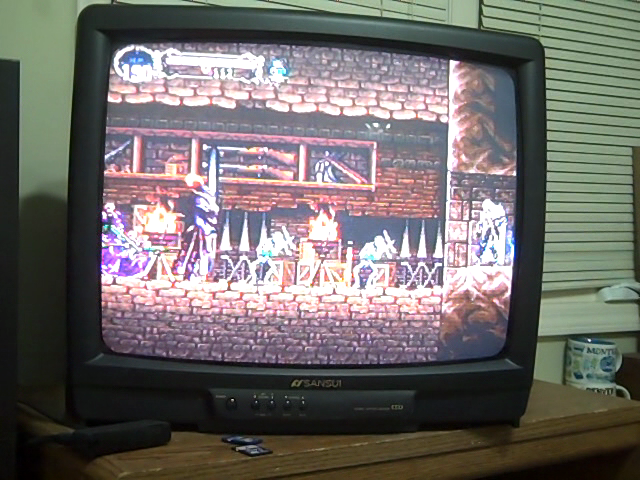
I tried to apply this to Castlevania: Symphony of the Night in real time in the above video. I did this in a very, very slap-dash manner, bringing back the lost old art of the Camcorder Let’s Play. I’d say that I did this out of an attempt to revive the format, but honestly it was a decision borne of convenience and disinterest in going through the rigamarole of setting up a capture card and OBS and everything properly.
SOTN is my favorite video game. I’ve made a habit of playing through it the past few years in the days following Christmas, and each time that I do this, I realize more about why I love the game. I try to exhibit this in the video, in which I find myself at the entrance to a corridor crowded with particularly annoying enemies that block my path to the Shield Rod, which is my preferred attack weapon to use for most of the game. I detest this corridor, but I need this weapon. I have two tactical decisions to choose from: Approach with caution and preparation, ducking behind the shield and striking with intention to gradually grind my way to the end of the corridor, or leap right into it, hoping that momentum and the brief invincibility spell that overcomes Alucard upon taking damage can carry me to the end of the corridor before I run out of health points. The second path is riskier, and still leaves me to have to work back through enemies in the corridor, but since the most annoying of the enemies (the Bone Muskets, which are skeletons with muskets that shoot bullets in quick succession from a screen away) can’t turn around, I’m mostly left to outduel the lumbering Armor Lords, which is an easier task than facing them and the Muskets head-on. Typically, I try to be cautious and well-prepared for my first few attempts at completing the room, but I give up and throw caution to the wind and eventually brute-force my way through the corridor.
I expected to demonstrate this in the video. I expected to fail a few times, give up on the virtue of preparation, and then reach my goal in an ugly, graceless fashion. This was to illustrate a point that, often, in my life, I over-prepare for things I ought to just throw myself into despite the risk of doing so.
What actually happened was that I decided to leave the Colosseum area in search of the Holy Water sub-item, which led me to explore more of the castle, including one of my favorite rooms in the game, the confession booth with the priest. The confession scene’s inclusion is purely an aesthetic decision, it does nothing to aid Alucard in progression, but I love what it provides to the castle. It has its own background music, unused anywhere else in the game. The priest only shows up in this room. One could complete the game and miss this room entirely, but I always stop in. On its face, it’s not necessary, completely ostentatious, but I think the developers’ capacity for ostentatiousness is what makes this game so special to me. There are so many of those little extra touches that make up Symphony of the Night, from that scene, to the spyglass at the bottom of the outer wall, to the boots that do nothing but make Alucard appear slightly talller. It’s a dense game, and not everything about it works perfeclty, but its extra wrinkles and nettles make me appreciate it even more.
I had this video set-up for a perfect comedic anticlimax. It took me ten-plus minutes to find the Holy Water. I was perfectly set to try my hand at patience and diligence once again before failing, resetting, and simply throwing caution to the wind. Yet, on the first try I made with Holy Water in tow… I made it. It was tedious, yes, but so satisfying to stand in front of the Bone Muskets and slash my way through them, having honorably worked my way through the heavies in front of them. Preparation and diligence had paid off when I expected them least to do so.
My 2024 was defined by that push-and-pull between diligence and spontaneity. It came to an all-too emphatic head back in September, when an impromptu trip to Chicago with my roommate saw his car breaking down on the side of the interstate south of Joliet and the tow truck driver admonishing us curtly, stating “It’s basic fucking maintenance, bro,” but it had been there as an undercurrent in many other situations. It will continue to be there as an undercurrent throughout my life, but I’ve learned that it’s not necessarily so firmly set. Preparation and spontaneity do not have to be in conflict in practice. One can feed the other.
This experience did not feel like a distraction. It felt allegorical. Perhaps my issue with video games is not that they are a distraction, but that I tend too often to use them as one. It takes more effort to see them as something that enriches my life and helps me to understand it, but the ends tend to justify it.


